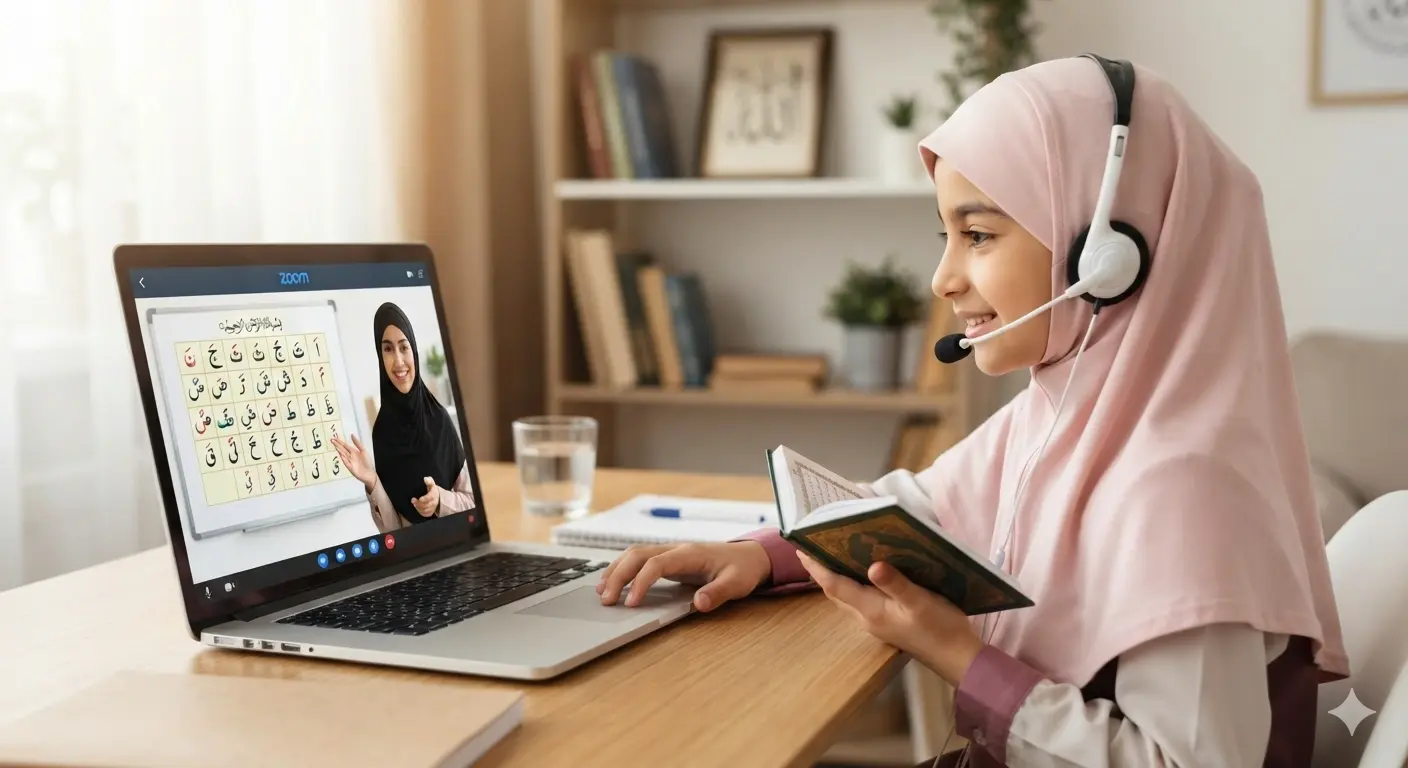
At the dining room table, a child straightens a mushaf, taps a tablet, and waits for a teacher’s warm “Assalamu alaikum.” For many families, Online Quran classes for kids feel more natural than a long drive across town after school.
That’s why these lessons keep growing in busy homes. Parents want safe, flexible Islamic learning that fits homework, dinner, and bedtime. A calm start often makes children more ready to listen and repeat. Before you enroll, it helps to know what children learn, how to choose a teacher, how much it usually costs, and how to keep lessons joyful at home. This guide walks through all of it in detail, so you can make a confident decision for your family.
- Loading contents…
Why Online Quran Classes for Kids Fit Modern Family Life
Modern family life runs on calendars, carpools, and quick meals. Online Quran lessons fit that rhythm because learning happens where your child already feels calm. In many homes, that alone lowers resistance. Instead of treating Quran study as one more place to drive to, parents fold it into a routine that already exists — right after homework, right before dinner, or right after Asr prayer.
Learn From Home Without the Stress of Travel
A lesson can start after a snack, not after a rushed drive. That saves time on school nights and leaves room for sports, homework, and family dinner. Parents also avoid weather, traffic, and late-evening pickups, so children arrive focused instead of tired. For families with more than one child, this matters even more, since two or three kids in different activities no longer compete for the same car and the same hour.
There is also a quieter benefit here: less travel means less friction before the lesson even starts. A tired, cranky child pulled out of the car is rarely ready to focus. A child who simply walks from the living room to the kitchen table, with a few calm minutes to settle, usually arrives in a better state of mind to learn.
A More Personal Learning Pace for Each Child
Many programs offer one-to-one or small-group sessions. That helps shy children speak up, beginners sound out letters slowly, and fast learners move ahead without waiting. Families also gain access to qualified teachers beyond their local area. Many parents notice the same practical benefits of online Quran classes when home learning removes distance and fixed travel schedules.
This personal pace also means a teacher can slow down on a tricky letter for as long as needed, without an entire classroom waiting. On the other hand, a child who already reads well doesn’t have to sit through material they’ve mastered. Over a few months, this flexibility tends to produce steadier, more confident progress than a one-size-fits-all classroom setting.
Access to Teachers From Anywhere in the World
Online classes remove the limits of geography entirely. A family living in a small town with no local Islamic school can still connect with an experienced Hafiz or Qari from a major city, or even another country. This widens the pool of available teachers significantly, which means parents can choose based on teaching style, qualifications, and personality fit, rather than simply picking whoever happens to be nearby.
For families living in non-Muslim-majority countries, this access can be especially valuable. Instead of settling for whatever local options exist, parents can connect their child with native Arabic speakers or certified Tajweed teachers thousands of miles away, all through a stable internet connection.
What Children Actually Learn in an Online Quran Class
Once parents know why the format works, the next step is understanding what fills each lesson. A well-structured online Quran class usually moves through a few clear stages, each building on the last.
Quran Reading, Pronunciation, and Tajweed Basics
Children often begin with Arabic letters, their sounds, and how letters join. Then they practice smooth reading, word by word and verse by verse. Tajweed teaches the rules of clear recitation, so each sound comes from the right place. Many families value online Tajweed classes for kids because careful pronunciation gives children a strong base early.
Early lessons typically focus on Makharij, the correct points where each Arabic letter is pronounced. From there, children move into basic Tajweed rules such as elongation, nasal sounds, and stopping signs. None of this is taught all at once; instead, a good teacher introduces one rule at a time, repeats it across several lessons, and only adds a new rule once the previous one feels comfortable.
Memorization, Short Surahs, and Daily Duas
After reading starts to settle, many teachers add short surahs, simple adhkar, and daily duas. Small targets matter here. A child who memorizes one short passage each week feels progress, and that feeling keeps the door open for the next lesson. Many programs begin with Surah Al-Fatiha and the shorter surahs from the last juz, since their length makes early success realistic.
Daily duas are often woven in alongside surah memorization — things like the dua before eating, the dua for leaving the house, or the dua before sleeping. Because children already say these phrases in daily life, they tend to stick faster than unfamiliar verses, which gives kids an early sense of accomplishment.
Islamic Manners and Love for the Quran
Good classes don’t stop at sounds and rules. Teachers also speak about adab, listening well, handling the mushaf with respect, and speaking kindly. Over time, the Quran becomes part of home life, not a subject a child wants to avoid.
This part of the lesson is easy to overlook, but it often matters most in the long run. A child who is taught to love the Quran, rather than simply decode it, is far more likely to keep reading it as a teenager and an adult. Teachers who weave in short stories of the Prophets, gentle reminders about good character, and patient encouragement tend to build that lasting connection.
Listening Skills and Confident Recitation Aloud
Many programs also dedicate time to listening practice, where children hear a verse recited correctly before attempting it themselves. This builds an ear for proper rhythm and pronunciation long before a child can read the words independently. Over time, this listen-and-repeat method also builds confidence in reciting aloud, whether in front of a teacher, a parent, or eventually a small gathering at home.
How to Choose the Right Quran Teacher for Your Child
A strong program depends less on flashy promises and more on the person teaching your child. The right teacher can make even a short daily lesson feel rewarding, while the wrong fit can turn Quran study into a daily struggle.
Look for Experience With Young Learners
Teaching kids takes a different touch. A good Quran teacher speaks clearly, corrects gently, and notices when a child is tired or confused. Short explanations, patient repetition, and cheerful encouragement matter more than long lectures.
It also helps to ask directly how many years of experience a teacher has working specifically with children, rather than adults. A teacher who has spent years reciting professionally may still struggle to hold a six-year-old’s attention, while a teacher with strong classroom instincts can keep even a restless child engaged for the full lesson.
Check Class Structure, Trial Lessons, and Communication
A trial class helps you watch the teacher’s pace, tone, and lesson flow. Clear goals also help, such as mastering letter recognition, improving Tajweed, or memorizing selected surahs. Parents often ask about the benefits of one-to-one online classes because regular feedback and personal attention make progress easier to track.
Beyond the trial lesson, ask how progress is communicated. Some academies send a short written summary after every class, while others offer a monthly report or a quick voice note. Neither approach is wrong, but knowing what to expect in advance prevents frustration later, especially for parents who like to stay closely involved in their child’s learning.
Make Sure the Setup Is Safe and Easy to Use
The platform should feel simple on the first day. Look for secure logins, stable audio, working video, and screen-sharing tools that don’t confuse your child. Parent access, class reminders, and easy rescheduling can remove a lot of stress.
It is also worth confirming who has access to recorded sessions, if any are kept, and how long they are stored. A trustworthy academy will be transparent about its privacy practices and happy to answer questions about screen recording, camera use, and how a child’s information is handled.
Ask About Qualifications and Ijazah
Many serious Quran teachers hold an Ijazah, a formal certification showing they have mastered correct recitation under a qualified teacher, often traced back through a chain of trusted scholars. While an Ijazah is not strictly necessary for early childhood lessons focused on letters and basic reading, it becomes more important as a child progresses into Tajweed and memorization.
It is reasonable to ask a prospective teacher about their qualifications, where they studied, and whether they hold any certification. A confident, experienced teacher will usually be glad to share this information rather than treat the question as intrusive.
Understanding the Cost of Online Quran Classes
Pricing for online Quran classes varies widely depending on the teacher’s experience, the length of each session, and whether lessons are one-to-one or in a small group. Generally speaking, one-to-one classes cost more than group sessions, simply because the teacher’s full attention goes to a single student.
What Affects the Price
Several factors typically influence cost: the teacher’s qualifications and years of experience, the number of weekly sessions, the length of each class, and whether the academy includes extras such as progress reports or recorded materials. A teacher with a strong Ijazah and years of experience teaching children may charge more than a newer tutor, but the difference in teaching quality can be well worth it for many families.
Free Trials and Flexible Packages
Most reputable academies offer a free trial class, which gives parents a no-risk way to judge fit before committing to a paid plan. Beyond the trial, many platforms offer flexible packages, ranging from a few sessions a week to daily lessons, so families can choose an option that matches both their budget and their child’s schedule. It is worth comparing a few different academies before settling on one, since pricing structures and what is included can differ significantly.
Simple Ways to Help Your Child Stay Excited About Quran Learning
Even the best class works better when home support feels light and steady. A teacher can only do so much in thirty minutes a day; the rest of the week is shaped by what happens at home.
Turn Lessons Into a Small Daily Habit
Ten or fifteen minutes at the same time each day beats one long session at the end of a hard week. A regular slot after Asr or before bedtime helps children know what comes next. Because the routine is short, they don’t feel buried by it.
Consistency, more than intensity, is what builds lasting memorization. A child who reviews a few lines daily for a month will usually retain far more than one who crams for an hour the night before a lesson. Treating Quran time like brushing teeth — short, daily, and non-negotiable — tends to produce the best long-term results.
Use Praise, Goals, and Gentle Rewards
Children bloom when progress feels seen. A sticker chart, a favorite dessert after a memorization goal, or a quiet word of praise from a parent can do more than pressure. Keep the focus on effort and consistency. Small, steady steps build stronger habits than fear of mistakes.
It also helps to celebrate effort, not just results. A child who tries hard but stumbles over a difficult word still deserves encouragement, since the goal at this stage is building a positive relationship with the Quran, not perfect recitation on the first attempt.
Create a Calm, Distraction-Free Learning Space
A quiet corner with good lighting, away from the television or noisy siblings, makes a noticeable difference in how well a child focuses during an online lesson. This space doesn’t need to be elaborate; a small table, a comfortable chair, and a stable internet connection are usually enough. Keeping the same spot for every lesson also helps children mentally shift into “learning mode” as soon as they sit down.
Involve the Whole Family When Possible
Children often stay more motivated when Quran learning feels like a shared family value rather than an individual task. Parents reciting alongside their child, even imperfectly, or siblings quizzing each other on a memorized surah, can turn what might feel like homework into something closer to a family activity. This doesn’t need to happen every day, but even occasional family involvement reinforces that Quran learning matters to everyone at home, not just to the child attending the lesson.
Be Patient With Setbacks
Some weeks will go smoothly, and others won’t. A busy school schedule, a tired evening, or a string of mistakes during recitation can dent a child’s motivation temporarily. During these moments, it helps to lower the pressure rather than increase it — a short review of something already mastered can rebuild confidence before moving forward again. Setbacks are a normal part of learning, and how a parent responds to them often shapes whether a child sees mistakes as discouraging or simply part of the process.
Common Questions Parents Ask Before Enrolling
What Age Should a Child Start Online Quran Classes?
Many academies accept children from around four or five years old, though lessons at this age tend to be short, playful, and focused on basic letter recognition rather than formal Tajweed. There is no single “right” age; what matters more is whether a child can sit reasonably still for the length of a session and follow simple instructions from a teacher on screen.
How Long Should Each Lesson Be?
For younger children, fifteen to twenty-five minutes is often plenty, since attention spans are naturally shorter at that age. Older children, particularly those further along in memorization or Tajweed, can often manage thirty to forty-five minute sessions without losing focus. A good teacher will adjust lesson length based on how a specific child responds, rather than applying the same format to every student.
How Many Days a Week Are Ideal?
Three to five sessions a week tends to strike a good balance between steady progress and avoiding burnout. Daily lessons can work well for highly motivated children, but for most families, a few consistent sessions a week, supported by short daily review at home, produces strong results without overwhelming a busy schedule.
Does My Child Need to Know Arabic Before Starting?
No prior knowledge of Arabic is needed. Most online Quran classes for kids are designed to start from zero, beginning with the alphabet and basic letter sounds before moving into reading. A good teacher will assess where a child is on day one and build the lesson plan around that starting point, rather than assuming any prior exposure to the language.
What Equipment Does My Child Need for Online Classes?
The basics are simple: a laptop, tablet, or smartphone with a working camera and microphone, plus a stable internet connection. Headphones can help reduce background noise and make it easier for a child to hear the teacher clearly. A printed mushaf or a Quran app on the device is also useful, since most teachers ask children to follow along visually rather than relying on listening alone.
Can Boys and Girls Learn Together in the Same Class?
This depends on the academy and the family’s preference. Many platforms offer separate class options for boys and girls, along with the choice of a male or female teacher, particularly as children grow older. Parents who prefer this setup should ask directly during enrollment, since policies vary from one academy to another.
What Happens if My Child Misses a Class?
Most academies offer some flexibility for rescheduling, especially when a parent provides advance notice. Policies differ, so it is worth asking before enrolling how missed classes are handled, whether makeup sessions are offered, and whether there is a limit on how many can be rescheduled in a given month. A clear, written policy on this from the start helps avoid confusion later.
How Can I Track My Child’s Progress Over Time?
Most reputable academies provide some form of regular progress tracking, whether through short written notes after each class, a monthly summary, or a simple chart showing which surahs and rules have been covered. Parents who want closer involvement can also ask the teacher directly during a brief check-in call every few weeks, which often gives a clearer picture than written reports alone.
Conclusion
A child doesn’t need a perfect study room or a packed schedule to grow with the Quran. What matters more is a kind teacher, a safe routine, and lessons that match the child’s pace.
When those pieces come together, online Quran classes can become one of the calmest parts of the week. Parents often start for convenience, but they stay because the learning feels personal and steady. Over time, children gain more than reading skill. They build comfort with Allah’s words, and that love can stay with them long after the screen turns off.
Whatever path a family chooses, the most important step is simply starting — with a trial class, a short daily habit, and a little patience. The rest tends to follow naturally.