Introduction
Artificial intelligence is changing the way people learn, work, and access information. Education is one of the areas where AI can provide new opportunities for students, teachers, and parents.
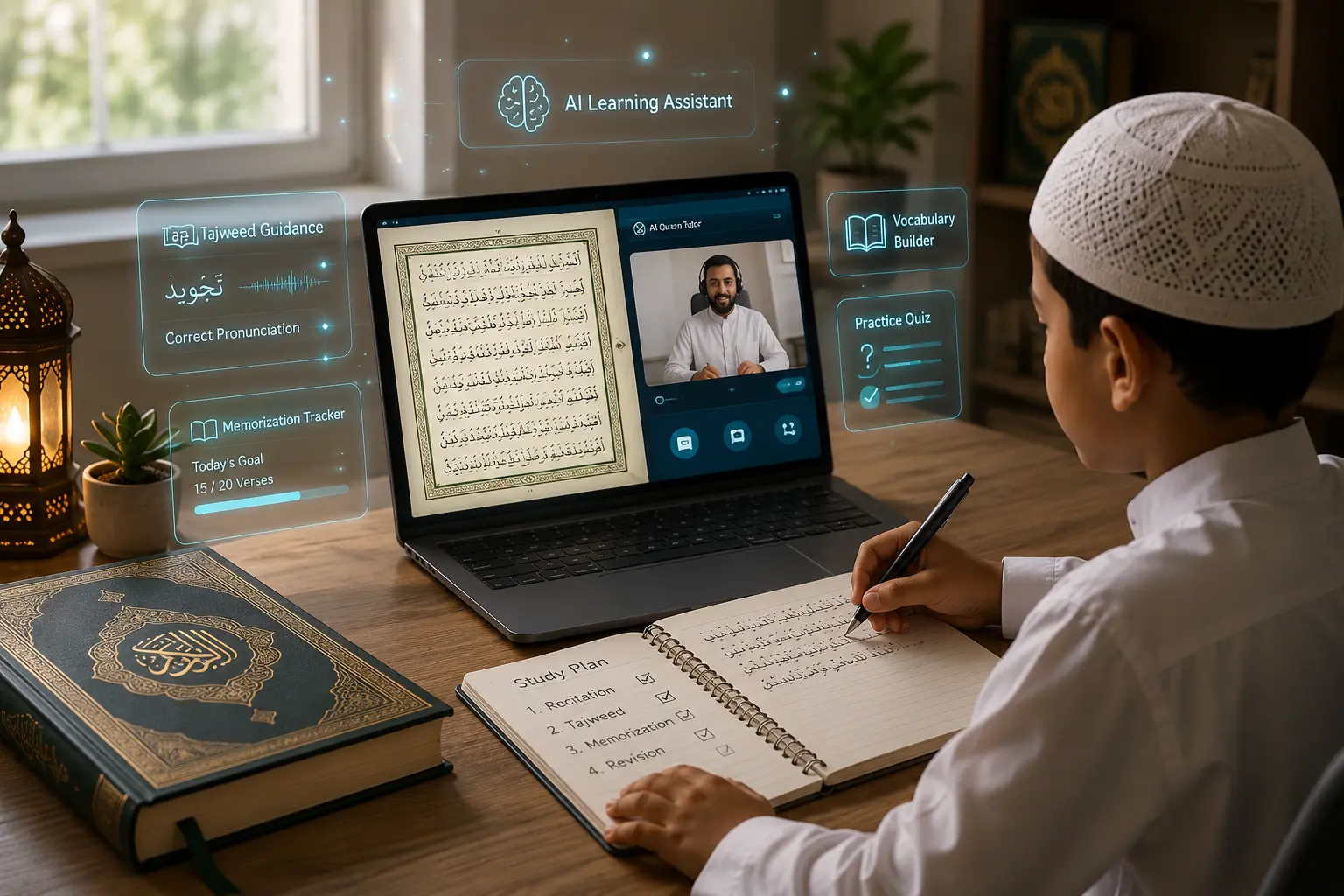
Quran learning is also becoming increasingly connected with modern technology. Students can now use digital resources, online Quran classes, educational applications, speech technology, and AI-powered tools to support their learning.
But an important question remains:
Can artificial intelligence really help students learn the Quran?
The answer is yes, when it is used responsibly as a learning aid.
- Loading contents…
AI can help students practice, review lessons, learn Quranic vocabulary, create revision exercises, organize study routines, and make learning more interactive. However, AI should not be treated as a replacement for a qualified Quran teacher or authentic Islamic sources.
The most useful approach is to combine AI-assisted Quran learning, qualified teachers, reliable Quran resources, and regular student practice.
What Is AI for Quran Learning?
AI for Quran learning means using artificial intelligence and AI-powered educational technology to support people who are studying the Quran.
AI can assist students with different learning activities. For example, it can help create quizzes, explain general concepts, organize revision exercises, practice vocabulary, and provide educational activities based on a student’s learning level.
AI can also be used alongside online Quran classes. A student may learn a lesson from a qualified teacher and then use appropriate technology for additional practice between lessons.
This creates a simple learning model:
Qualified Quran Teacher → Student Learning → AI-Assisted Practice → Revision → Teacher Feedback
The teacher remains an important part of the learning process, while AI can act as an additional educational assistant.
How Can Artificial Intelligence Help Students Learn the Quran?
Artificial intelligence can support Quran students in several different ways.
It is important, however, to understand that AI should be used for support and practice, not as the final authority on Quranic or Islamic knowledge.
1. Personalized Quran Learning
Every student learns differently.
Some students may already know how to read Arabic, while others may be complete beginners. Some may need additional practice with pronunciation, while others may want help with memorization or vocabulary.
AI-assisted learning can help create educational activities based on a student’s current level.
For example, a student learning Quranic vocabulary could ask an appropriate AI tool to create simple vocabulary exercises for practice.
This can make personalized Quran learning more accessible.
2. Quran Vocabulary Practice
Understanding Quranic vocabulary can help students develop a better understanding of the words they encounter while studying.
AI can be used to create:
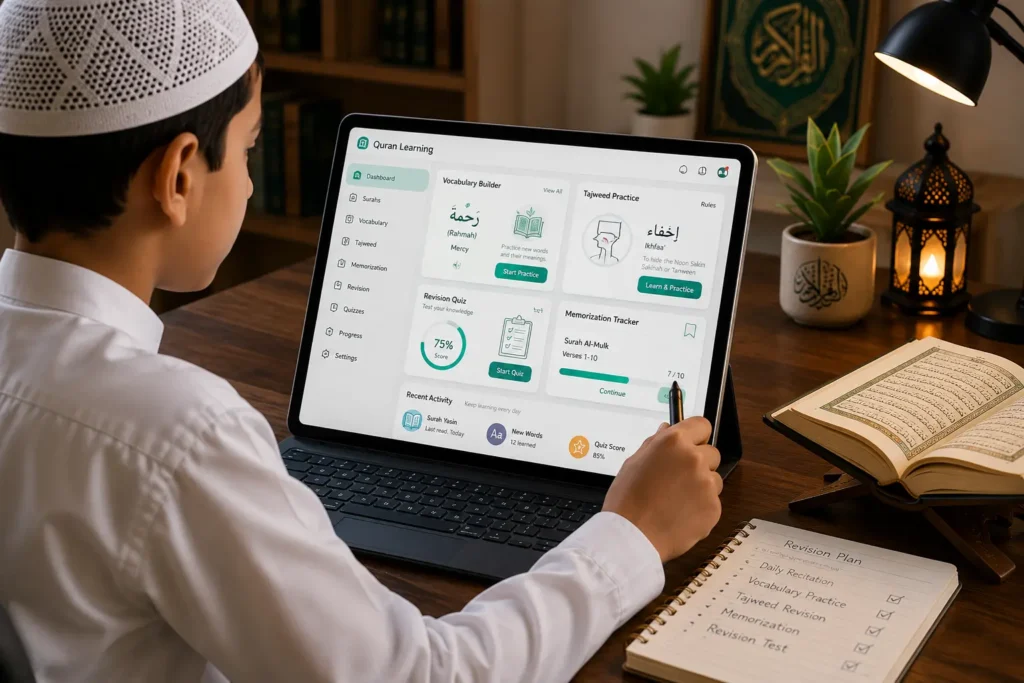
- Vocabulary quizzes
- Word-matching exercises
- Flashcards
- Simple revision questions
- Arabic vocabulary practice
- Word-repetition activities
However, students should verify meanings and explanations through reliable Quranic and Islamic resources, especially when the meaning depends on context.
3. Quran Revision
Revision is an essential part of learning.
After completing an online Quran lesson, students can use technology to create additional practice activities.
For example, AI can help generate a simple revision quiz based on topics the student has already studied.
A student could review:
- Arabic letters
- Quranic vocabulary
- Previously studied Surahs
- General Tajweed concepts
- Memorization goals
- Islamic studies topics
This can make revision more engaging, especially for students who enjoy interactive learning.
AI for Quran Memorization
Quran memorization requires consistency, repetition, revision, and guidance.
AI can potentially support students by helping them organize a memorization routine.
For example, an AI tool could help a student create a weekly revision plan based on portions already being studied.
AI-assisted activities could include:
- Revision schedules
- Memorization checklists
- Practice questions
- Repetition plans
- Progress tracking ideas
- Vocabulary exercises related to memorized Surahs
However, AI should not be considered a replacement for a qualified teacher who can listen to the student’s actual recitation and provide appropriate correction.
The best approach is to use technology for organization and additional practice, while the teacher supervises the student’s Quran memorization and recitation.
Can AI Help With Quran Recitation?
Technology has made significant progress in speech and voice recognition. This creates interesting possibilities for Quran learning.
AI-powered speech technology may help students practice reading aloud and identify areas that require additional attention.
However, students should be careful when using AI for Quran recitation.
Quran pronunciation and Tajweed involve detailed rules and accurate application. An AI system may not always understand every aspect of a student’s recitation correctly.
Therefore, AI-generated feedback should not automatically be treated as authoritative.
A Better Approach
Students can use technology for additional practice while continuing to have their recitation checked by a qualified Quran teacher.
The teacher can listen to the student’s recitation, identify mistakes, explain the correct pronunciation, and monitor improvement over time.
This is one of the most important principles of responsible AI Quran education:
Use AI to support learning, but use qualified teachers and authentic sources for authoritative Quran instruction.
AI for Quran Learning for Kids
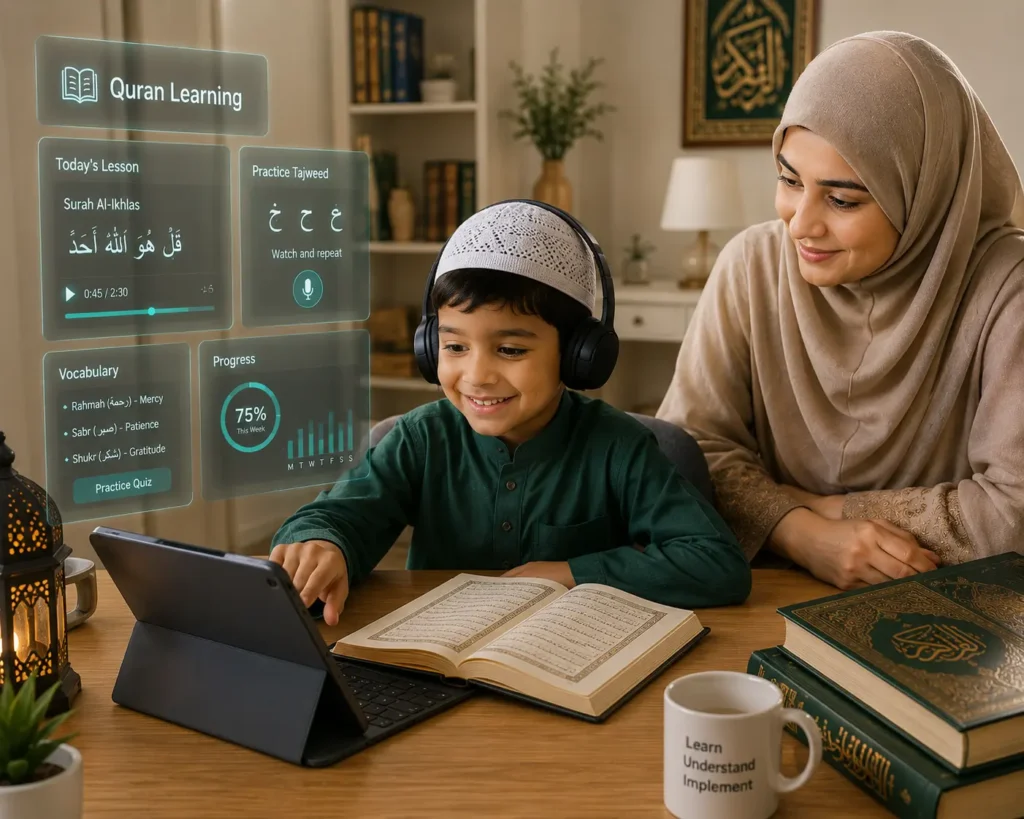
Children are growing up in a digital environment, and many are already familiar with interactive educational technology.
This creates opportunities for AI for kids Quran learning, but it also creates additional responsibilities for parents and teachers.
AI can potentially make Quran-related learning activities more engaging for children through:
- Interactive quizzes
- Vocabulary games
- Revision exercises
- Question-and-answer activities
- Memorization practice
- Educational stories and activities
- Simple learning explanations
However, children should not be left alone to determine whether information generated by AI is religiously correct.
Parents and teachers should remain involved.
How Kids Can Use AI for Quran Learning Safely
AI can be useful for children, but safe AI use for Quran learning should always involve adult supervision.
1. Parents Should Supervise AI Use
Parents should know what AI tools their children are using and how those tools are being used.
2. Religious Information Should Be Verified
AI can sometimes produce inaccurate or incomplete information.
If a child receives an answer about Quranic interpretation, Islamic rulings, Hadith, or other religious matters, the information should be checked with reliable sources and qualified teachers.
3. Children Should Not Depend on AI Alone
AI should be an additional learning tool rather than the child’s main Quran teacher.
A qualified teacher can understand the student’s individual needs in ways that an AI system cannot fully replicate.
4. Protect Children’s Privacy
Children should not share unnecessary personal information with AI tools.
Parents should teach children basic digital safety and supervise the information they enter into online services.
5. Keep Learning Age-Appropriate
AI activities should match the child’s age, understanding, and learning level.
Simple quizzes and vocabulary exercises may be appropriate for younger students, while older students may benefit from more advanced educational activities.
AI vs. a Qualified Quran Teacher
One of the most important questions about artificial intelligence and Quran learning is whether AI could eventually replace Quran teachers.
For Quran education, it is better to think of AI as a supporting technology rather than a replacement for teachers.
| AI-Assisted Learning | Qualified Quran Teacher |
|---|---|
| Can provide practice activities | Provides structured instruction |
| Can create quizzes | Can assess the student’s actual learning |
| Can help with revision | Can listen to Quran recitation |
| Can provide educational assistance | Can correct pronunciation and Tajweed |
| Can help organize study activities | Can adapt teaching to the student’s needs |
| Available as a digital tool | Provides human guidance and supervision |
| May produce inaccurate information | Can direct students toward reliable sources |
The strongest model is not necessarily AI versus teacher.
It can be:
AI + Teacher + Student
The teacher provides instruction and correction.
AI provides additional educational support.
The student practices consistently.
This combination can make online Quran learning more flexible and engaging.

Benefits of AI-Assisted Quran Learning
When used correctly, AI technology can offer several potential benefits to Quran students.
Personalized Practice
Students can receive practice activities based on their learning needs.
Flexible Learning Support
AI tools can provide additional practice outside regular lesson times.
Interactive Learning
Quizzes, flashcards, questions, and other activities can make revision more engaging.
Better Revision
Students can use AI-assisted activities to review previously learned material.
Support for Parents
Parents can use technology to create educational activities and revision ideas for their children.
Support for Teachers
Teachers can potentially use AI to prepare supplementary learning materials, quizzes, and practice activities.
Greater Access to Educational Resources
Digital technology can make additional learning resources easier to access.
However, these benefits depend on using reliable tools responsibly and verifying important information.
How Quran Teachers Can Use AI as a Teaching Assistant
AI is not only useful for students.
Teachers may also be able to use AI technology as a teaching assistant.
For example, a Quran teacher could use AI to help prepare:
- Revision questions
- Vocabulary exercises
- Practice worksheets
- Learning activities
- Lesson ideas
- Student revision schedules
- Simple quizzes
The teacher should then review the material before giving it to students.
This is particularly important for Quran and Islamic education because AI-generated content can contain mistakes.
The teacher remains responsible for ensuring that the learning material is accurate and appropriate.

AI Tools for Quran Learning
The phrase AI tools for Quran learning can refer to several different types of technology.
Rather than depending on one particular tool, students and parents should consider what type of assistance they actually need.
AI Chat and Educational Assistants
These may help with general educational questions, quizzes, vocabulary practice, and revision activities.
Speech and Voice Technology
Speech recognition technology may provide additional opportunities for reading and pronunciation practice.
Digital Quran Applications
Digital Quran resources can help with reading, listening, memorization, and revision.
Educational AI Tools
AI-powered educational tools can help students create flashcards, quizzes, study plans, and other practice materials.
The important point is to understand the purpose and limitations of each tool before using it for Quran education.
Can AI Teach Tajweed?
AI can potentially support Tajweed learning by providing explanations, exercises, and practice materials.
However, Tajweed is an area where students should be particularly careful.
Reading and pronunciation cannot always be properly evaluated through text-based AI.
A student may understand a Tajweed rule theoretically but still pronounce a letter incorrectly.
A qualified Quran teacher can listen to the student’s recitation and provide direct correction.
Therefore:
AI can support Tajweed study, but it should not replace qualified human instruction.
Students should use reliable educational resources and have their actual recitation checked by a knowledgeable teacher.
How Parents Can Use AI to Support Their Children’s Quran Learning
Parents do not need to ask AI to become their child’s Quran teacher.
Instead, they can use AI as an additional educational resource.
For example, after a child learns a lesson from a qualified teacher, parents might use suitable technology for:
Revision
Create simple questions based on material the child has already learned.
Vocabulary
Practice selected Quranic words.
Memorization
Create a simple revision checklist.
Learning Activities
Create age-appropriate educational exercises.
Study Planning
Help organize practice around the child’s regular Quran classes.
This approach keeps the teacher at the center of Quran instruction while allowing technology to provide additional support.
Example: A Safe AI-Assisted Quran Learning Routine
Imagine a child is learning a new Surah through online Quran classes.
The learning process could look like this:
Step 1 — Live Quran Lesson
The child learns with a qualified Quran teacher.
Step 2 — Teacher Correction
The teacher identifies pronunciation, reading, or memorization areas that need improvement.
Step 3 — Home Practice
The child practices the lesson at home.
Step 4 — AI-Assisted Revision
A parent may use an appropriate AI tool to create simple revision activities related to the lesson.
Step 5 — Teacher Follow-Up
During the next lesson, the teacher checks the child’s progress.
This creates a balanced approach:
Teacher → Learning → Practice → AI-Assisted Revision → Teacher Feedback
Limitations of AI in Quran Education
While AI has many potential benefits, it also has important limitations.
AI Can Make Mistakes
AI systems can generate information that sounds convincing but is inaccurate.
AI Does Not Replace Scholarship
Religious knowledge should be obtained from reliable Quranic and Islamic sources and qualified scholars or teachers.
AI May Not Understand Context
Some Quranic and Islamic concepts require knowledge of context, Arabic, Tafsir, Hadith, and scholarly interpretation.
AI Cannot Fully Replace Human Teaching
A teacher can observe a student’s progress, understand their difficulties, and provide personalized guidance.
Recitation Requires Human Attention
Pronunciation and Tajweed require careful listening and correction.
Children Need Supervision
Young students should not independently rely on AI for religious education.
These limitations do not mean AI has no value.
They mean that AI should be used responsibly.
AI for Islamic Education
The role of AI is not limited to Quran reading.
Artificial intelligence may also support broader AI Islamic education when used carefully.
Possible educational applications include:
- Islamic vocabulary
- General educational quizzes
- Learning activities
- Revision exercises
- Islamic history learning
- Basic Islamic studies
- Educational flashcards
- Study organization
But the same principle applies:
AI-generated religious information should be verified through trustworthy Islamic sources.
Technology can make information easier to access, but easy access does not automatically guarantee accuracy.
The Future of Quran Education
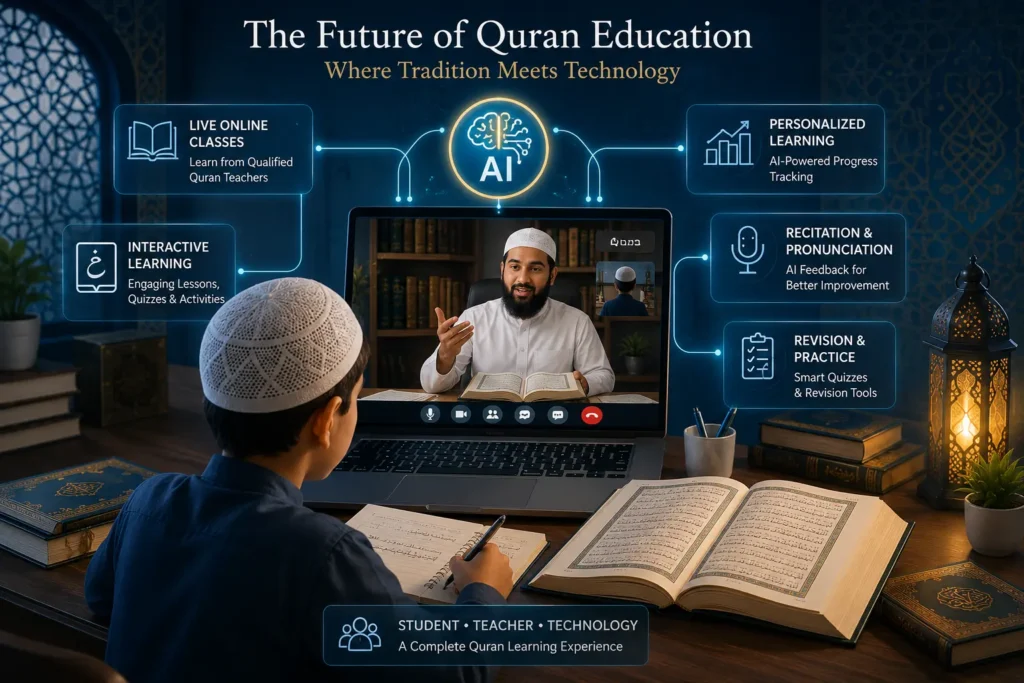
The future of Quran education will likely continue to combine traditional teaching methods with modern technology.
Online Quran classes have already made it possible for students to study with teachers from their homes.
AI may add another layer of educational support.
Future learning environments could potentially include:
- Personalized learning systems
- Intelligent revision tools
- Speech-assisted practice
- Interactive Quran learning
- Digital memorization support
- Personalized educational activities
- AI-assisted teacher resources
- More accessible online Quran education
However, technological development should not remove the human element from Quran education.
The Quran is not simply a collection of information to memorize.
Students also need guidance, discipline, correct recitation, understanding, good manners, and a meaningful relationship with their learning.
Technology can support these efforts, but it should be used wisely.
How AI Can Work With Online Quran Classes
For students already taking online Quran classes, AI can potentially become a useful supplementary tool.
A student might attend a live class with a teacher and then use technology for additional practice.
For example:
Live Quran Class
↓
Teacher explains the lesson
↓
Student practices at home
↓
AI-assisted revision
↓
Student reviews difficult areas
↓
Teacher checks progress
This approach combines the strengths of technology with the personal guidance of a qualified teacher.
For students who want to learn Quran online, the goal should not be to replace the teacher with technology.
The goal should be to use technology to make learning and practice more effective.
Is AI the Future of Quran Learning?
AI may become an increasingly important part of educational technology, including Quran learning.
However, it is better to think of AI as one part of the future of Quran education, rather than the entire future.
The strongest approach will likely combine:
- Qualified Quran teachers
- Authentic Quranic resources
- Online learning
- Educational technology
- AI-assisted practice
- Parent involvement
- Consistent student effort
When these elements work together, technology can support students without replacing the essential human guidance involved in Quran education.
Practical Tips for Using AI for Quran Learning
If you want to use AI as part of your Quran learning routine, keep these principles in mind.
1. Use AI as an Assistant
Don’t treat AI as your final religious authority.
2. Verify Important Information
Check religious explanations through reliable sources and qualified teachers.
3. Keep Your Teacher Involved
Continue learning Quran with a qualified teacher, especially for recitation and Tajweed.
4. Use AI for Practice
Quizzes, vocabulary, revision, and educational activities are practical uses.
5. Supervise Children’s AI Use
Parents should monitor how children use AI.
6. Protect Privacy
Avoid sharing unnecessary personal information with AI services.
7. Don’t Let Technology Replace Practice
AI can provide activities, but students still need regular Quran reading and revision.
Frequently Asked Questions
Yes. AI can support Quran learning through revision activities, vocabulary practice, quizzes, study planning, and other educational exercises. It should complement qualified Quran teachers and reliable Islamic resources.
AI should not be considered a replacement for a qualified Quran teacher. Teachers provide human guidance, listen to recitation, correct pronunciation, and understand individual student needs.
Children can potentially use AI as an educational support tool, but parents and teachers should supervise its use and verify religious information.
AI can help organize revision schedules, create practice activities, and support memorization routines. However, students should continue reciting to and receiving feedback from a qualified teacher.
AI can provide explanations and practice materials about Tajweed, but students should not depend on AI alone for correct recitation. A qualified teacher should check actual pronunciation and application of Tajweed rules.
AI can be useful when used responsibly. Students and parents should verify religious information, use trustworthy resources, protect personal information, and keep qualified teachers involved.
Potential benefits include personalized practice, interactive revision, vocabulary exercises, study planning, memorization support, and additional learning activities.
AI may provide increasingly personalized and interactive learning support. However, qualified teachers, authentic sources, and responsible human guidance should remain important parts of Quran education.
Final Thoughts
AI for Quran learning represents an interesting opportunity to combine modern technology with traditional Quran education.
Artificial intelligence can help students practice, revise, organize their learning, study vocabulary, create educational activities, and explore new ways of learning.
For children, AI can potentially make revision and educational activities more interactive. For parents, it can provide additional ideas for supporting learning at home. For teachers, AI may help prepare supplementary educational materials.
But there is an important boundary.
AI should support Quran learning, not replace qualified Quran teachers or authentic Islamic sources.
The most effective approach is to combine qualified teaching, reliable Quran resources, regular practice, responsible technology, and student commitment.
As technology continues to develop, AI may become a useful assistant in Quran education. Used wisely, it can help students make their learning more flexible, interactive, and engaging while keeping the teacher and authentic knowledge at the center.